Core Java Programming
Java still runs the enterprise, and Mumbai hires for it constantly. This covers the language, the object model, collections and the JDBC basics that job descriptions ask for.
- Java 21
- IntelliJ IDEA
- Maven
- +2
Every serious technical interview is a data structures interview. You build each structure by hand in C and C++, then drill the patterns that recur across company assessments.
What you will be able to do
At a glance

Full syllabus
11 modules · 55 topics · 198 concepts
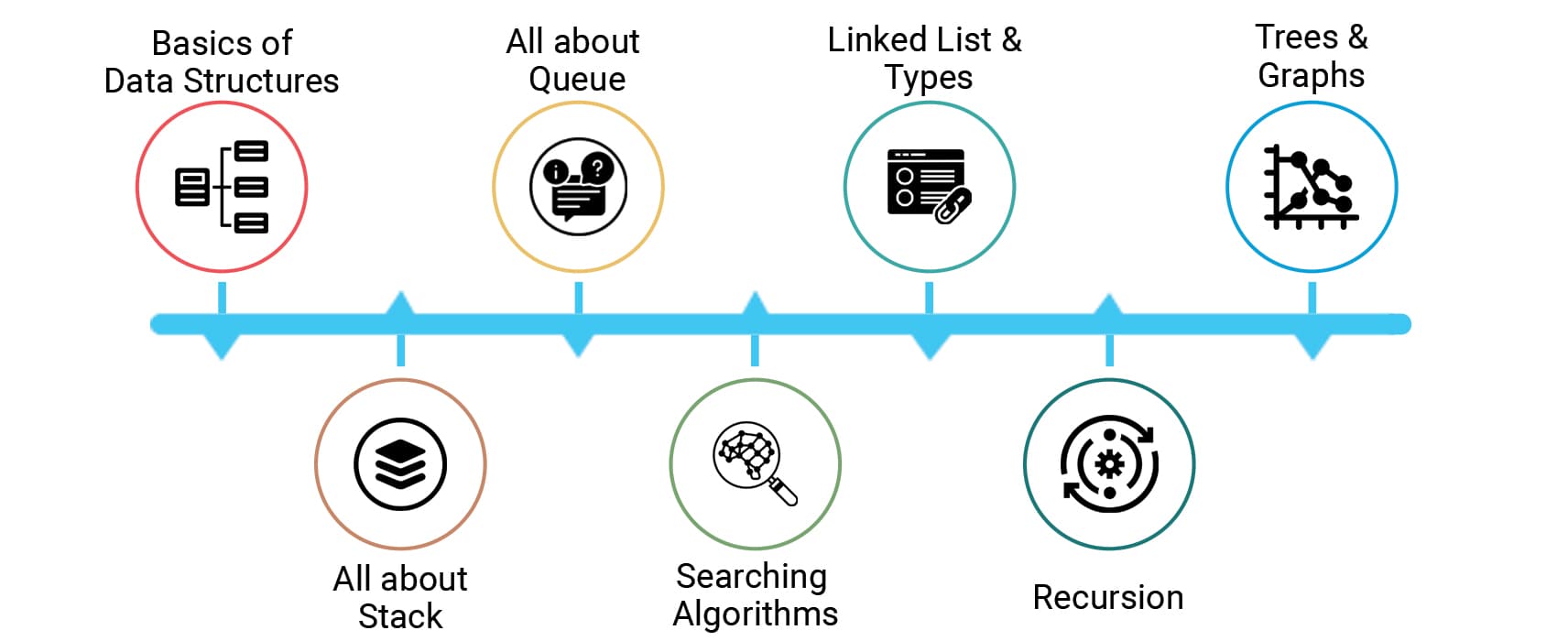
Asymptotic notation
Analysing code
Space complexity
Amortised analysis
Correctness
You can derive the time and space complexity of code you have just read.
Static and dynamic arrays
Two pointers
Sliding window
Prefix sums
String algorithms
You can solve the standard array and string patterns without brute force.
Recursion mechanics
Divide and conquer
Backtracking
Recursion to iteration
You can convert a recursive idea into working code and bound its cost.
Elementary sorts
Efficient sorts
Stability and in-place
Non-comparison sorts
Binary search
You can implement the major sorts and pick the right one for the constraints.
Singly linked lists
Doubly and circular lists
Classic operations
Cycle detection
Array versus list
You can manipulate linked structures without losing or leaking a node.
Stacks
Monotonic stack
Queues
Deques
Priority queues
You can recognise a stack or queue problem from its description.
Binary trees
Traversals
Binary search trees
Balanced trees
Heaps
Tree problems
You can traverse and manipulate trees both recursively and iteratively.
Hash functions
Collision handling
Load factor and rehashing
Hashing patterns
Sets versus maps
You can design a hash-based solution and reason about its worst case.
Representation
Traversal
Topological sort
Shortest paths
Minimum spanning trees
You can model a problem as a graph and choose the right traversal.
Recognising DP
Memoisation to tabulation
One-dimensional DP
Two-dimensional DP
Interview framing
You can find the state, write the recurrence, and convert it to a table.
Pattern recognition
Timed practice
Explaining your approach
Debugging under pressure
University preparation
You can classify an unseen problem into a pattern within a couple of minutes.
5 builds you keep
A trie holding a real word list, ranked by frequency, answering prefix queries fast enough to run on every keystroke. The structure behind every search bar you have used.
Real station and line data as a weighted graph, with Dijkstra finding the route and interchange penalties modelled as edge weights. A graph problem where you can check the answer against your own commute.
A hash map and a doubly linked list working together to evict in O(1). The exact structure sitting in front of most production databases, and one of the most-asked interview questions.
The component an API puts in front of itself to stop one client swamping it. A deque of timestamps, and a decision on every request.
Two stacks and a command representation, handling the cases that break naive implementations: undo after new input, and redo invalidation.
Hands on with
Before you enrol
Both, deliberately. The structures and their implementations are the university syllabus; the patterns, timed practice and complexity discussion are what an assessment round tests. They are the same material approached from two ends.
We build the structures by hand in C and C++ because that is where you can see the memory, then use C++ STL for pattern practice. If you are heading for interviews, knowing what a vector or a map costs you is the point.
The last module is about exactly that: stating the approach before coding, reading constraints to infer the expected complexity, and working under a clock. It is a practised skill, not a personality trait.
The structure modules each carry implementation work, and the pattern module runs on timed sets. The number matters less than coverage of the patterns, which is what the last module is organised around.
You need to be comfortable with pointers, structs and functions. Our C course or the first half of the C++ course is enough. Starting data structures without pointer fluency is the usual reason people stall.
Where this leads
One skill on a CV is a hobby. These are the courses students take alongside this one, in the order that builds an actual role.
Java still runs the enterprise, and Mumbai hires for it constantly. This covers the language, the object model, collections and the JDBC basics that job descriptions ask for.
Object orientation is the idea every interview asks about and most people half-understand. Sixty hours of C++ taught as it is actually written in 2026: smart pointers over raw new, move semantics, concepts, ranges and the standard library, with the exam syllabus covered alongside.
The shortest route from no code at all to a working, employable skill. Sixty hours of live teaching that starts at absolute beginner and ends with five projects and a deployed web application in your portfolio.