Core Java Programming
Java still runs the enterprise, and Mumbai hires for it constantly. This covers the language, the object model, collections and the JDBC basics that job descriptions ask for.
- Java 21
- IntelliJ IDEA
- Maven
- +2
The shortest route from no code at all to a working, employable skill. Sixty hours of live teaching that starts at absolute beginner and ends with five projects and a deployed web application in your portfolio.
What you will be able to do
At a glance

Full syllabus
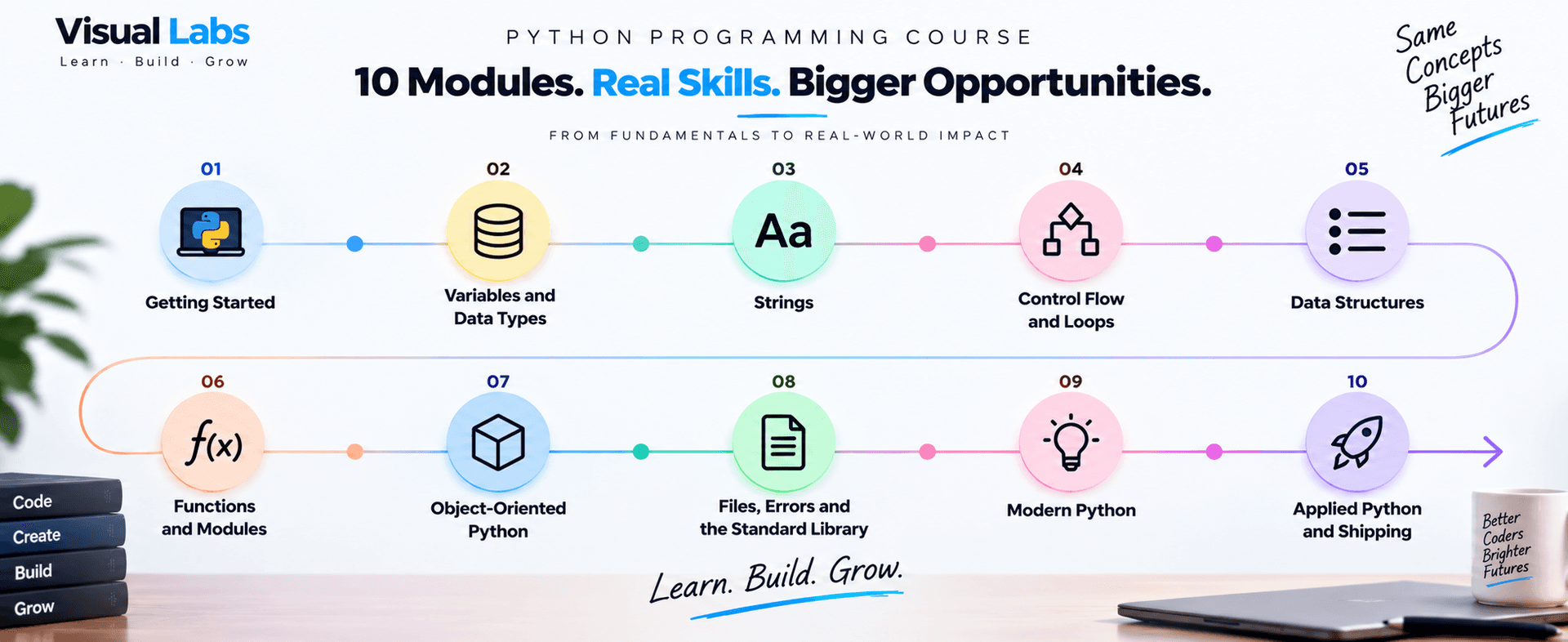
10 modules · 49 topics · 202 concepts
Installing Python
Running code
Virtual environments
Packages
You can run Python from the terminal and manage a project environment.
Variables
Numbers
Booleans and None
Type conversion
Input and output
You can predict the type of any expression and convert between types safely.
String basics
String methods
Formatting
Escape and encoding
Regular expressions
You can slice, search and reformat text without reaching for a loop.
Conditionals
Loops
Loop control
Comprehensions
Iterables and generators
You can express any loop idiomatically rather than translating from C.
Lists
Tuples
Dictionaries
Sets
Choosing a structure
You can pick the right structure and explain its lookup cost.
Defining functions
Argument handling
Scope
Functional tools
Modules and packages
You can write functions with clean signatures and organise them into modules.
Classes and instances
Methods
Dunder methods
Inheritance
Data classes
You can design a class with proper state and behaviour, and know when not to.
File handling
Structured formats
Exceptions
Useful standard modules
Logging
You can read and write real file formats and handle failure deliberately.
HTTP and APIs
Web scraping
Tabular data
Cleaning
Databases
You can pull data from a file, an API or a web page and reshape it.
Command-line tools
A web application
Testing
Version control
Deploying
You can build a small web application and put your work on GitHub.
5 builds you keep
Takes yesterday and today from the same system, finds what was added, removed and silently changed, and reports the drift. The task every finance and operations team does by hand in Excel.
Scrapes a real listing page on a schedule, stores each observation in SQLite, and alerts on a change. Teaches scraping, storage and the fact that websites change under you.
Pulls from a public API with pagination and rate limits, normalises the response into tables, and handles the request that fails halfway through a run.
Forms, validation, a database and sessions. Deployed to a free host with real environment variables, so the difference between localhost and production is something you have felt.
Runs on a schedule, reads from a database, writes a formatted report, emails it, and logs enough that you can tell what happened when it fails at 6am.
Hands on with
Before you enrol
No. The first module assumes nothing, including that Python is not yet installed. It is deliberately the slowest part of the course because everything afterwards depends on it.
Python, if you want to be writing useful programs soonest. It has less ceremony, so you spend your attention on the logic rather than on the syntax. Java is the better second language.
Python alone is a skill, not a role. It becomes employable when pointed at something: data analysis, backend development or automation. This course ends with a deployed application, and most students then take Data Analytics or Full Stack to aim it at a specific job.
Not here. This is the language and the data-handling foundation. Machine learning is a separate course, and attempting it without solid Python and pandas is the usual reason people stall.
Five projects and a deployed web application, on your own GitHub. The last module covers writing a README that explains what you built, because an unexplained repository does nothing for you.
Where this leads
One skill on a CV is a hobby. These are the courses students take alongside this one, in the order that builds an actual role.
Java still runs the enterprise, and Mumbai hires for it constantly. This covers the language, the object model, collections and the JDBC basics that job descriptions ask for.
The theory and the practice together. ER modelling and normalisation for your university paper, and real SQL against real schemas for the job.
Every serious technical interview is a data structures interview. You build each structure by hand in C and C++, then drill the patterns that recur across company assessments.