Datastructures using C and C++
Every serious technical interview is a data structures interview. You build each structure by hand in C and C++, then drill the patterns that recur across company assessments.
- C
- C++
- GDB
- +2
Object orientation is the idea every interview asks about and most people half-understand. Sixty hours of C++ taught as it is actually written in 2026: smart pointers over raw new, move semantics, concepts, ranges and the standard library, with the exam syllabus covered alongside.
What you will be able to do
At a glance

Full syllabus
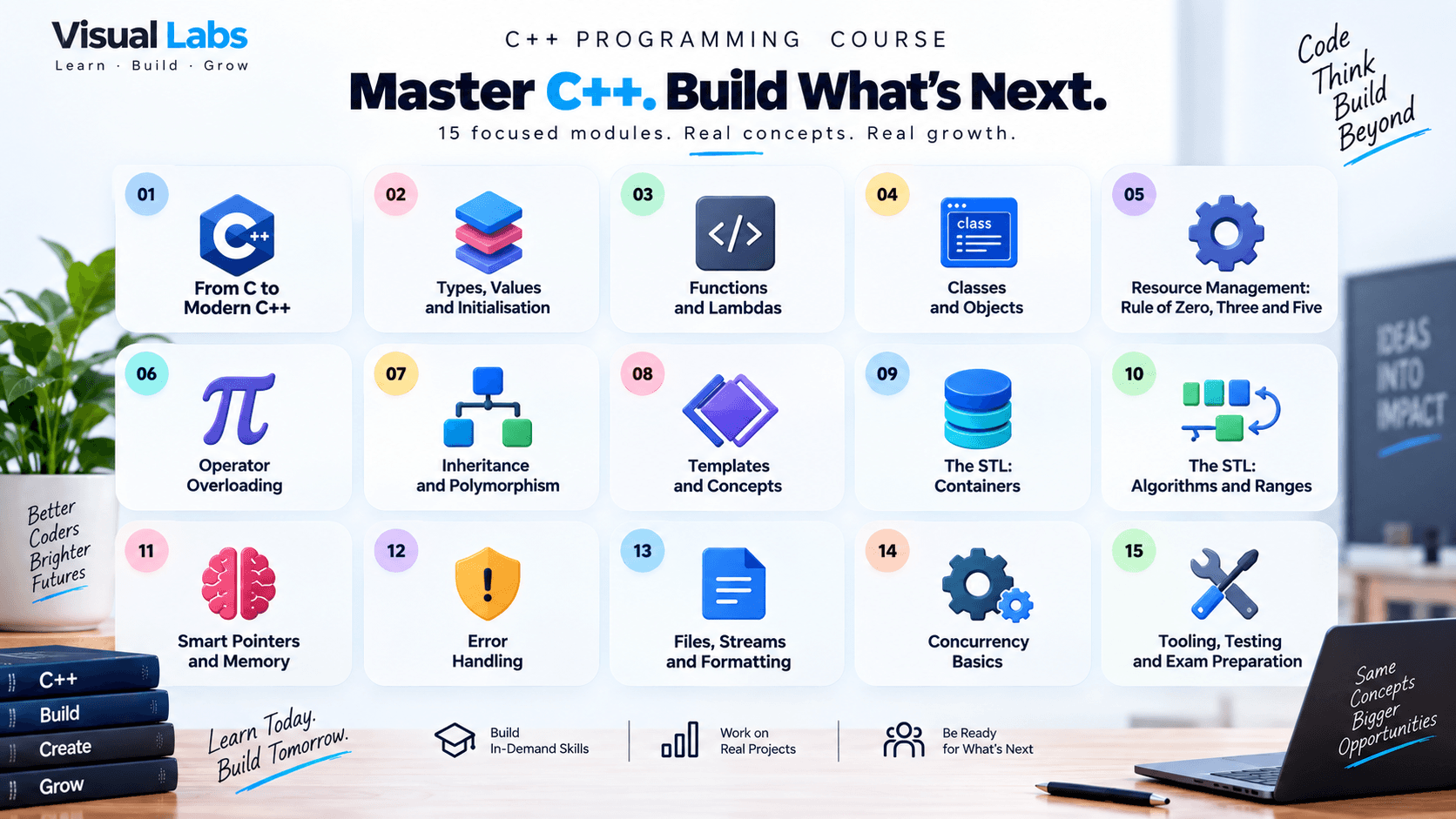
15 modules · 75 topics · 264 concepts
Why C++ exists
The standard versions
Compiling a C++ program
Namespaces
Input and output
You can read modern C++ and explain why it avoids new and delete.
Fundamental types
Initialisation
const and constexpr
References
Scope and lifetime
You can initialise anything correctly and explain auto, const and references.
Overloading
Passing and returning
Lambdas
std::function and callables
Inline and templates basics
You can write a lambda with the right capture and pass it to an algorithm.
Class fundamentals
Constructors
The destructor
Static and const members
friend and encapsulation
You can design a class whose invalid states are unrepresentable.
RAII
Copy semantics
Move semantics
The rules
Copy-and-swap
You can explain RAII and write a class that owns a resource safely.
Member versus non-member
Arithmetic and compound
Comparison
Stream operators
Subscript, call and conversion
You can overload operators for a value type and know which ones to leave alone.
Base and derived
Virtual functions
Abstract classes and interfaces
Runtime polymorphism
Multiple inheritance
Composition over inheritance
You can explain dynamic dispatch and say when composition beats inheritance.
Function templates
Class templates
Specialisation
Concepts
Variadic templates
You can write a constrained generic function and read a template error.
Sequence containers
Associative containers
Unordered containers
Container adaptors
Iterators
You can choose the right container from its complexity and iterator guarantees.
Non-modifying algorithms
Modifying algorithms
Sorting and searching
Numeric algorithms
Ranges
You can express a transformation as algorithm calls instead of a hand-written loop.
unique_ptr
shared_ptr
weak_ptr
Raw pointers today
Memory diagnostics
You can express ownership in the type system with the right smart pointer.
Exceptions
Exception safety
Alternatives to exceptions
Assertions and invariants
You can write exception-safe code and justify your error-handling strategy.
File streams
Reading patterns
String streams
Formatting
Filesystem
You can read and write files and format output without printf.
Threads
Mutual exclusion
Condition variables
Atomics and futures
Data races
You can start threads and protect shared state without deadlocking.
Build systems
Debugging
Testing
Reading assembly
University preparation
You can build with CMake, test with a framework, and answer the viva.
5 builds you keep
The allocation strategy game engines and trading systems use to avoid touching the heap in a hot loop. Placement new, explicit destruction, and a benchmark against plain new.
Operator overloading with a reason to exist. Your type gets used by a renderer that writes an actual image, so a wrong operator is visible rather than theoretical.
A hash map and an intrusive list working together, the structure sitting in front of most production databases. Built to be move-only, so ownership is enforced by the compiler.
One producer, several consumers, a mutex and a condition variable. The piece every job runner is built around, and the one that exposes whether you understand data races.
RAII file handles, a templated index, exception-safe writes and a CMake build. Crash it halfway through a write and show the file is still readable.
Hands on with
Before you enrol
It helps but it is not assumed. The first module maps C ideas onto C++ for people who have done our C course, and builds them from scratch for people who have not. If you have never programmed at all, start with C or Python instead.
That is the problem this course exists to solve. We teach current C++ because that is what gets hired, and cover the older syntax your exam still asks for alongside it. You will be able to write both and explain why one is obsolete.
For anything where speed or memory matters it is still the default: game engines, trading systems, databases, embedded work, and the internals of Python itself. It is also the language that teaches you what the others are hiding.
All of the object-orientation, inheritance, polymorphism, templates, file handling and exception modules map directly onto the Mumbai University and MSBTE OOP papers. The modern C++ material is extra, and it is the part that matters in an interview.
Yes, and most students go straight on to it. Knowing the STL containers and their complexity guarantees is half of what the data structures course builds on.
Where this leads
One skill on a CV is a hobby. These are the courses students take alongside this one, in the order that builds an actual role.
Every serious technical interview is a data structures interview. You build each structure by hand in C and C++, then drill the patterns that recur across company assessments.
C teaches you what the machine is actually doing. Forty-eight hours covering the whole language, with pointers and memory taught visually rather than hand-waved, and every module mapped to the Mumbai University and MSBTE syllabus.
Java still runs the enterprise, and Mumbai hires for it constantly. This covers the language, the object model, collections and the JDBC basics that job descriptions ask for.