Short Term
Intermediate to Advanced4 monthsCertification
Machine Learning
The algorithms, properly understood. You implement the core models before reaching for a library, so you know why one fails and another works.
- Python
- scikit-learn
- pandas
- +2
Certification programme
From neural network fundamentals to working with large language models. An applied AI programme for people who want to build systems, not just talk about them.
What you will be able to do
At a glance
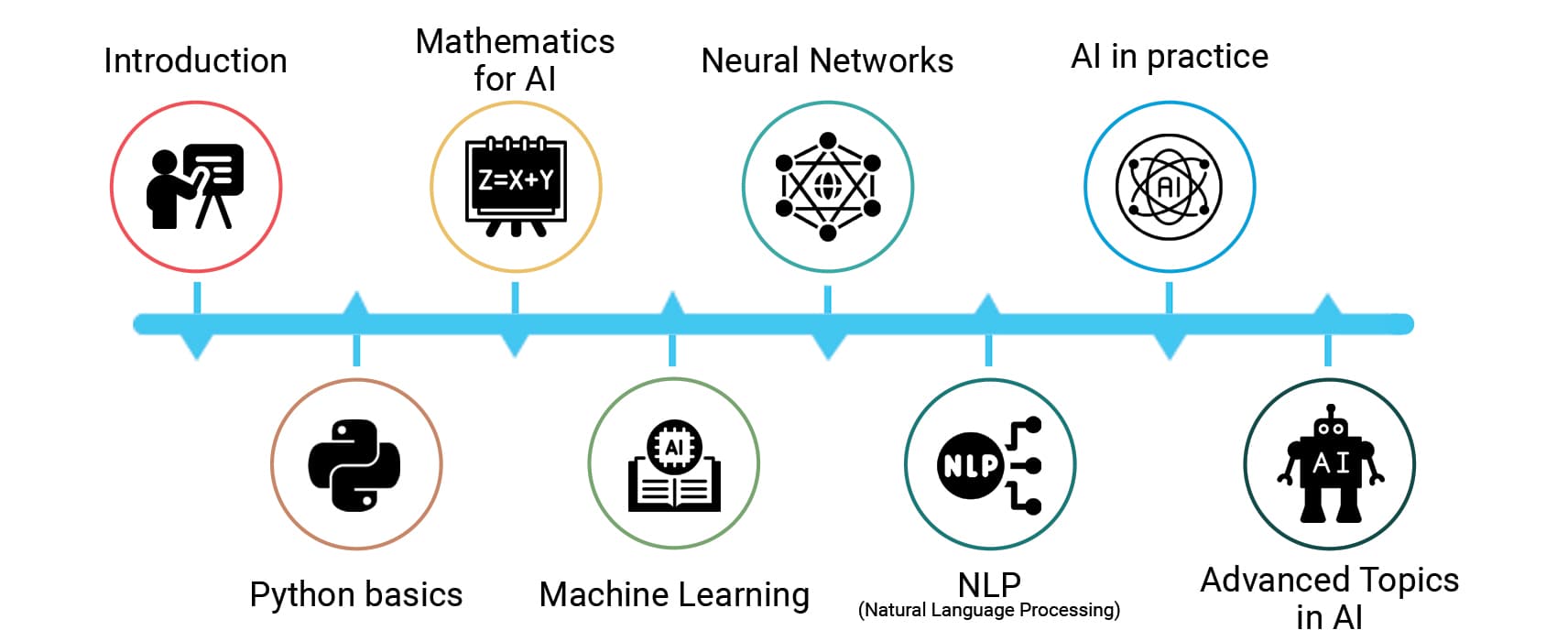
Full syllabus
8 modules · 42 topics · 163 concepts
Definitions
A short history
Capabilities and limits
The ecosystem
Setting up
You can place any AI system in context and say what it can and cannot do.
The neuron
Activations
Forward propagation
Loss functions
Backpropagation
Training loop
You can implement forward and backward passes and explain every step.
Optimisation in practice
Regularisation
Initialisation and stability
Data handling
Debugging training
You can diagnose a failing training run and fix it.
Images as data
Convolutional networks
Architectures
Transfer learning
Beyond classification
Evaluation
You can build an image model using transfer learning and evaluate it properly.
Text preprocessing
Classical approaches
Embeddings
Transformers
Using pretrained models
You can solve a language task with the right tool for its size and budget.
How LLMs work
Prompting as engineering
Retrieval augmented generation
Generative models beyond text
Evaluating generative output
You can build a grounded LLM application and evaluate its output.
Serving models
Working with model APIs
System design
Monitoring
Edge and on-device
You can ship an AI feature with sensible cost, latency and failure behaviour.
Bias and fairness
Privacy
Security of AI systems
Transparency
Keeping current
You can assess an AI system for risk and explain your assessment.
5 builds you keep
A small, imbalanced image dataset where missing a defect costs far more than a false alarm. Transfer learning, augmentation, and a threshold chosen from the cost of each error.
Scanned forms in mixed quality, with fields extracted, confidence scored, and anything uncertain routed to a human. The layout that real document-AI systems use.
RAG built properly: chunking that respects structure, retrieval you have measured, answers that cite sources, and a test set that catches it answering from memory instead of the documents.
Take a task a large hosted model does adequately and expensively, fine-tune a small open model to do it well and cheaply, and compare quality, latency and cost honestly.
A deployed system with input validation, prompt-injection defences, output checking, cost monitoring and a documented list of what it must not be used for.
Hands on with
Before you enrol
Machine learning is mostly tabular data and classical algorithms, which is what most business problems are. This is neural networks: vision, language and generative models. Doing ML first is the easier path, though not required.
Not one you own. The course uses free cloud notebook GPUs for training, and the transfer-learning approach we teach deliberately keeps runs short enough to fit inside free tiers.
The value has shifted from training models to building systems around them: retrieval, evaluation, guardrails and cost. That shift is why half this course is about what surrounds the model, not the model itself.
You will implement backpropagation once by hand, which needs the chain rule and matrix multiplication. After that it is mostly engineering. We build the required maths in the second module rather than assuming it.
This one first if you want to understand how the models work. Agentic AI assumes you can already work with an LLM API and focuses on systems that plan and use tools. Several students take both, in that order.
Where this leads
One skill on a CV is a hobby. These are the courses students take alongside this one, in the order that builds an actual role.
The algorithms, properly understood. You implement the core models before reaching for a library, so you know why one fails and another works.
The complete analyst toolkit in one programme: spreadsheets, SQL, visualisation and Python, applied to real datasets and finished with a dashboard you can defend in an interview.
What happens beneath your program, taught at the Linux terminal so the theory stays concrete. Doubles as the foundation for cloud and cybersecurity work.